
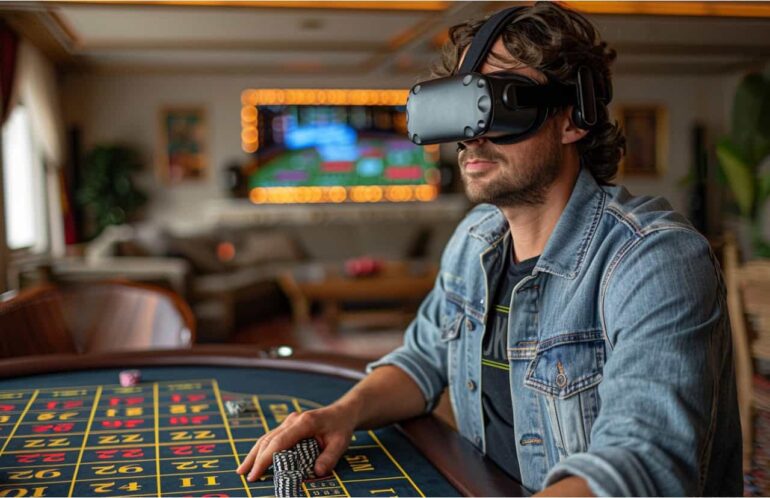
Virtual Reality (VR) is no longer a futuristic novelty—it’s poised to transform multiple sectors, and gambling is one of the most compelling frontiers. As hardware becomes more accessible and immersive tech advances, the future of virtual reality in gambling promises to reshape how people bet, socialize, and experience risk and reward. In this article, we explore the deep currents shaping that transformation—technologies, business models, regulation, and societal risks.
Why VR and Gambling Are a Natural Fit
Before diving into the future, it helps to understand why VR is so well suited to gambling:
- Immersion & presence: VR’s power lies in transporting users into a three-dimensional environment. In a gambling context, that means walking into a virtual casino, interacting with dealers, watching the roulette wheel spin, hearing ambient chatter—experiences far beyond clicking buttons on a screen.
- Social interactivity: Traditional online gambling often lacks the human connection of brick-and-mortar casinos. VR enables real-time voice, gestures, and avatar-based interaction—players can chat, celebrate wins, or sit together at a table.
- Novel monetization: In a VR environment, gambling can integrate virtual goods, avatar wearables, décor, and other microtransactions, creating new revenue streams beyond bets themselves (as already seen in social VR “metaverse” gambling spaces).
- Blending online and land-based: For real casinos, VR can extend their brand into remote markets—virtual branches of real casinos, hybrid venues combining physical and virtual space.
- Enhanced user retention: The richer experience helps platforms retain users longer—VR is an engagement driver in a competitive online gambling space.
These advantages lay the foundation for a far-reaching evolution in the gambling ecosystem.
Key Trends Shaping the Future
1. Hardware democratization and performance improvements
One of the biggest constraints historically has been VR hardware cost and performance. But the trajectory is promising:
- VR headsets are becoming lighter, cheaper, and more comfortable, with better resolution and lower latency.
- Wireless and standalone systems reduce the friction of tethered setups.
- Upgrades to display panels, refresh rates, and field-of-view widen the gap between “good enough” and “immersive.”
- Future haptic feedback, full-body suits, and tactile controllers will let users feel the pull of a slot lever or the clink of a poker chip.
As adoption rises, the barrier to entry lowers, enabling broader reach.
2. Blockchain, NFTs, and token economies
The marriage of VR gambling with blockchain-backed economies offers intriguing possibilities:
- Bets, winnings, and deposits could leverage crypto or stablecoins, making cross-border play seamless.
- Smart contracts can ensure provably fair gaming, transparency in payouts, and enforce play rules automatically.
- NFTs and digital wearables may be integrated into VR casinos—players could own custom avatar outfits, decorative items, or exclusive tables, which they trade or use within the gambling ecosystems.
- Virtual casinos in metaverse platforms already exhibit these dynamics: graffiti, skins, avatar wearables, and in-world economies surrounding games. One study of a social virtual world found that a single poker implementation drove a disproportionate share of visits and wearable trades.
This fusion brings new layers of ownership, scarcity, and secondary markets into gambling.
3. The virtual venue as a global marketplace
VR dissolves geopolitical and geographic barriers:
- A player in New York can join a table with someone in Tokyo, creating a global gambling floor.
- Virtual casinos can offer multi-venue hubs (themed rooms, VIP lounges, race tracks) without requiring physical real estate.
- Tournaments and events can transcend borders—VR casinos could host global poker championships or virtual sports betting arenas with tens of thousands of spectators.
- The concept of a metaverse casino emerges: a persistent world where players walk, interact, gamble, socialize, and even own virtual property.
This global, persistent space changes the scale and scope of competition.
4. AI & intelligent game dynamics
Virtual reality gambling will likely be augmented by advanced AI at multiple levels:
- Smart dealers and NPCs: AI-powered dealers can react, converse, and adapt—making VR play feel more natural even beyond player-vs-player tables.
- Adaptive odds, dynamic game design: Systems can tailor game difficulty, jackpot frequency, or side bets based on real-time engagement metrics.
- Behavioral analytics: Platforms will analyze player behavior (session length, bet sizes, loss aversion) to personalize offers, bonuses, or even suggest breaks—raising both revenue and ethical concerns.
- AI moderation and safety: In VR spaces, AI can monitor chat, detect harassment or risky behaviors, and intervene—essential in preserving a healthy environment.
The combination of AI and VR enables far richer, more responsive gambling experiences.
5. Responsible gaming and regulatory frameworks
If VR gambling is to scale sustainably, responsible gaming must be baked in, not bolted on:
- VR environments offer opportunities to control triggers more tightly (e.g., visual cues, pacing, pop-up interventions).
- Platforms can enforce cooldowns, time limits, loss thresholds, and dynamically nudge or pause play based on indicators of addiction risk.
- Transparent identity and age verification is essential in immersive virtual settings.
- Regulators will demand robust oversight—ensuring fairness, security, anti-money laundering compliance, and data privacy in a 3D space.
- In regulated jurisdictions, virtual casinos may operate under the same licensing requirements as physical ones—but enforcing rules in a virtual space presents novel legal challenges.
Balancing innovation and protection will be a major battleground.
Potential Use Cases That Will Dominate
Here are some high-impact applications we expect to see:
Virtual Casino Halls
Grand, themed casino environments where players stroll, choose games, move between rooms, observe other players, and place bets—replicating the walk-in casino experience.
VR Poker & Table Games
Multiplayer poker, blackjack, baccarat in fully social settings, with voice, gestures, animation, and AI dealers filling gaps when needed.
Live-Event Betting Arenas
Imagine watching a virtual horse race, soccer match, or esports tournament in VR, placing live bets from your seat, interacting with other spectators, and even placing side wagers on ambient actions (e.g. “what’s the next goal? Next corner?”).
Immersive Slot Worlds
Slots not as static reels but as interactive 3D worlds—users might physically reach to spin levers, pull handles, or explore a themed environment tied to the slot’s narrative.
VR Betting Lounges & Social Spaces
Spaces where gamblers gather socially—chat, spectate, share tips, watch leaderboards, and hop into games—all in a persistent metaverse-like world.
Hybrid AR/VR Experiences
Augmented reality overlays in physical casinos or bars that enhance real-world gambling with VR features (e.g. virtual overlays, bonus content, social viewing).
Challenges and Roadblocks
Even a robust vision must wrestle with hurdles:
- Hardware adoption lag: Not everyone owns a VR headset; many are still unfamiliar or uncomfortable with VR.
- Network and latency: High-fidelity VR demands low latency and high throughput—5G, edge computing, and optimized compression will be essential.
- User safety & addiction risk: The immersive nature can intensify gambling impulses—platforms must vigilantly manage addiction risk.
- Regulation complexity: Virtual spaces blur jurisdiction. Where does a VR casino operate? Under which laws?
- Security & fraud: VR environments add new attack surfaces—avatar spoofing, virtual asset theft, identity exploits, and hacking of blockchain-backed components.
- Interoperability fragmentation: Multiple proprietary VR platforms might fragment player bases and hinder universality.
- Game variety and quality: To rival traditional casinos, VR platforms must offer a wide library of high-quality titles, graphics, and mechanics, which is an investment-intensive effort.
Overcoming these will require technical innovation, user education, and regulatory alignment.
What the Data Suggests
The VR gambling market shows strong growth projections:
- Analysts forecast that global VR gambling could grow at a compound annual growth rate (CAGR) of 30–35% over the next decade, reaching multi-billion-dollar revenues.
- The broader VR gaming market is on track to grow at ~21–22% CAGR through 2030.
- Early adoption is strongest in regions with favorable regulation and strong internet infrastructure.
- Emerging metaverse gambling experiments suggest that a single VR casino offering can drive massive user engagement and in-world economies in decentralized virtual worlds.
These trends point to a future where VR gambling is not niche—it could become one of the pillars of digital entertainment.
Ethical and Social Considerations
As VR gambling evolves, it brings profound social implications:
- Addiction risk escalation
Immersion magnifies emotional engagement. The boundary between “game mode” and “real life” can blur. Platforms must proactively integrate safe-play mechanisms. - Social inclusion & exclusion
VR gambling may exclude users who lack access to hardware or strong connectivity, deepening digital divides. - Normalization of gambling
If gambling becomes ambient in social VR worlds, it may normalize wagering among younger or more impressionable users, especially if avatar economies mimic play. - Data and privacy
VR captures far richer data—gestures, gaze, spatial position, biometrics. Protecting that data from misuse is critical. - Economic inequality in metaverse economies
Early entrants may capture disproportionate rewards in virtual asset markets, creating digital economic disparities.
Addressing these concerns will define whether VR gambling becomes a responsibly managed, accepted domain—and not a Pandora’s box.
Real-Life Scenarios: What Users Will Experience
- You sit at a virtual blackjack table under ambient lighting, listening to the shuffle of cards, seeing avatars of other players, chatting casually—and placing your bet by physically sliding chips.
- During a live sporting event, you’re virtually seated in a stadium, watching real-time feed, placing side bets, socializing with spectators, and seeing dynamic overlays showing odds or stats.
- You walk through a VR casino lobby, pick a slot game shaped like an ancient temple, explore its corridors, trigger bonus rooms, and physically “pull” a lever with motion controllers.
- You outfit your avatar with rare skins, special chip cases, or VIP lounge access tokens—digital wearables that enhance prestige or access within the gambling metaverse.
These aren’t sci-fi—they’re plausible next steps.
The Role of “The Future of Virtual Reality in Gambling”
(Here is your anchor text: the future of virtual reality in gambling is not just a vision—it is underway. The immersive and evolving nature of this domain is pushing boundaries in engagement, monetization, and regulation.)
By embedding this concept early, we set the tone: this article doesn’t merely speculate—it aligns with active trends reshaping the gambling world.
Frequently Asked Questions
Q: Will VR replace traditional online casinos entirely?
A: No. It’s more likely to complement current platforms. Many players prefer simpler, low-threshold games on 2D devices. VR will cater to high-engagement users, premium tiers, and hybrid experiences rather than displace all online gambling.
Q: How soon might VR gambling become mainstream?
A: Widespread penetration may take 5–10 years. The pace depends on how fast VR hardware costs drop, regulatory paths clear, and content ecosystems mature.
Q: Is VR gambling legal in most jurisdictions?
A: Not yet. Many regions lack laws specific to virtual or metaverse gambling. Laws around online gambling generally apply—but regulators will need to clarify how those laws extend into immersive virtual spaces.
Q: What about responsible gaming in VR?
A: Leading VR gambling platforms must integrate tools like time limits, self-exclusion, pop-up alerts, cooling-off periods, and real-time behavioral analytics to detect problematic play.
Q: Can VR gambling work without cryptocurrencies or blockchain?
A: Yes—traditional fiat payment systems can still work in VR. But blockchain offers advantages in transparency, fairness, and global interoperability, which many VR gambling ventures will explore.
Q: Will social VR worlds integrate gambling?
A: Many already are experimenting. Virtual worlds with avatar economies often include casino-like mini-games (e.g. poker, slot mini-experiences). As boundaries blur between social VR and gambling environments, those integrations may deepen.
Q: What role will regulation play?
A: Regulation will be pivotal. Licensing, age verification, tax regimes, cross-border enforcement, fairness standards, and virtual asset governance will all require new legal frameworks adapted to immersive environments.
Closing Thoughts
The future of virtual reality in gambling is not just a novelty or side experiment—it’s a frontier where immersion, finance, social gaming, regulation, and technology converge. As VR hardware becomes more capable and accessible, blockchain and AI layer deeper complexity, and regulators adapt to new landscapes, the gambling world may look very different within a decade. For operators, it’s a chance to reimagine the casino; for players, it’s an invitation into entirely new dimensions of play—with both opportunity and responsibility in equal measure.